Surname List
Name Index
Sources
Sixth Generation
92. 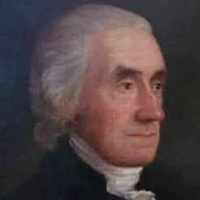 Robert Treat PAINE16 was born on 12 March 1730 in Boston, Suffolk County, Massachusetts Bay Colony, British Colonial America.9,16 After 1750 he was in Boston, Suffolk County, Massachusetts Bay Colony, British Colonial America.9,16 He was a graduate of Harvard College. He initially served as a Chaplain to the Troops, but became a Lawyer. He later was a Delegate to the Provincial Congress at Concord, a Member of the Continental Congress at Philadelphia, the Attorney General of Massachusetts, and a Judge of the Supreme Court of Massachusetts. On 4 July 1776 he was in Philadelphia, Philadelphia County, Pennsylvania Colony, British Colonial America. He was one of the signers of the Declaration of Independence.
At the end of the Second Continental Congress the 13 colonies came together to petition independence from King George III. With no opposing votes, the Declaration of Independence was drafted and ready for all delegates to sign on the Fourth of July 1776.
While many think the Declaration was to tell the King that they were becoming independent, its true purpose was to be a formal explanation of why the Congress voted together to declare their independence from Britain.
The Declaration also is home to one of the best-known sentences in the English language, stating, “We hold these truths to be self-evident, that all men are created equal, that they are endowed by their Creator with certain unalienable Rights, that among these are Life, Liberty and the pursuit of Happiness. Robert died on 12 May 1814 at the age of 84 in Boston, Suffolk County, Massachusetts Bay Colony, British Colonial America.16 Obituary Notes: "Robert Treat Paine was a native of Massachusetts, born in 1731. He was expected, by family tradition, to become a Minister. He got high marks at the Boston Latin School and was admitted to Harvard College, where he graduated in 1749. He taught school for a while and then began the study of theology. Because of his frail health, Paine set out to build up his strength by working on the sea. He spent some years as a merchant marine visiting the southern colonies, Spain, the Azores, and England. When he returned home he decided to pursue the law. He was admitted to the bar of Massachusetts in 1757. He first set up office in Portland, Maine (then part of Massachusetts) and later relocated to Taunton, Massachusetts. In the trials of British soldiers following the Boston Massacre, Paine served as associate prosecuting attorney.
He was elected to the Provincial Assembly in 1770 and that body selected him in 1774 to attend the first Continenetal Congress. Paine served on committees which formed the rules of debate, and later served as chairman of the committee charged with acquiring gunpowder for the Continental Army. He also signed the final appeal to the king, known as the Olive Branch Petition, in 1775. Paine was reelected to represent Massachusetts at the Continental Congress of 1776. He participated in the debates leading to the resolution for Independence and his signature appears on the Declaration. According to comments made by Benjamin Rush, Paine was known in Congress as the "Objection Maker," because of his habit of frequent objections to the proposals of others. These objections were eventually taken lightly, for as Rush commented, "He seldom proposed anything, but opposed nearly every measure that was proposed by other people..."
In 1777 Paine was elected attorney general of the state of Massachusetts. He was then serving on the legislative committee to draft the first constitution of the state under the new federation. He moved back to Boston in 1780 where he helped found the American Academy of Arts and Sciences. Governor Hancock offered him an appointment to the bench of the Supreme Court in 1783 but he declined. That offer was made again in 1796 and he accepted. He retired after some 14 years, in failing health, then died at the age of 83."
He was buried in Boston, Suffolk County, MA.16 in the Granary Burying Ground.
Robert Treat PAINE and Sarah COBB were married on 28 February 1770 in Boston, Suffolk County, Massachusetts Bay Colony, British Colonial America.9,16 They were the parents of at least 4 sons and 4 daughters. Sarah COBB16, daughter of Thomas COBB and Lydia LEONARD, was born on 15 May 1744 in Taunton, Bristol County, MA.16 She died on 6 June 1810 at the age of 66 in Boston, Suffolk County, MA.16
Robert Treat PAINE and Sarah COBB had the following children:
104 | i. | Robert PAINE Jr.16 was born in 1770.16 He died in 1798 at the age of 28.16 |
105 | ii. | Sally PAINE16 was born in 1772.16 She died in 1823 at the age of 51.16 |
106 | iii. | Thomas PAINE16 was born in 1773.16 He died in 1811 at the age of 38.16 |
107 | iv. | Charles PAINE16 was born in 1775.16 He died in 1810 at the age of 35.16 |
108 | v. | Henry PAINE16 was born in 1777.16 He died in 1814 at the age of 37.16 |