Surname List
Name Index
Sources
22nd Generation
2527232. 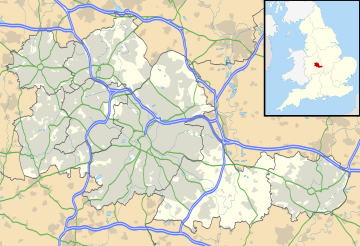 Radulphus GRESWOLD was born in 1279 in Solihull, Warwickshire, England.1169,1170,1279 From Wikipedia: "Solihull is a market town and the administrative centre of the Metropolitan Borough of Solihull in the West Midlands County, England. Solihull is situated on the River Blythe in the Forest of Arden area. The town is located 8 miles (12 km) southeast of Birmingham, 13 miles (21 km) west of Coventry and 18 miles (29 km) northwest of Warwick.
Solihull itself is mostly urban; however, the larger borough is rural in character, with many outlying villages, and three quarters of the borough designated as green belt. The town and its borough, which has been part of Warwickshire county for most of its history, has roots dating back to the 1st century BC, and was further formally established during the medieval era. Today the town is famed as, amongst other things, the birthplace of the Land Rover car marque, the home of the British equestrian eventing team and is considered to be one of the most prosperous areas in the UK.
Solihull's name is commonly thought to have derived from the position of its arden stone parish church, St Alphege, on a 'soily' hill. The church was built on a hill of stiff red marl, which turned to sticky mud in wet weather.
The land now forming Solihull was once covered in the ancient Forest of Arden. The earliest known settlement in the area was at Berry Mound, Shirley, which was the site of an Iron Age Hill Fort, a fortified village protected by earth banks, dating back to the 1st century BC and which covered approximately 11 acres (4.5 ha). The name Shirley means either 'a bright clearing' or 'a border clearing' in the Forest of Arden. During the later Iron Age the River Cole which feeds the River Blythe, is believed to have been the border between the Corieltauvi and the Cornovii, with Solihull forming the junction of the two powerful Celtic Tribes.
Throughout the Roman occupation of Britain it was held that no Roman roads made it through the Forest of Arden because it was so dense. The nearest known major Roman settlements being at Coleshill on the Solihull border, Metchley Fort (around 8.5 miles north west), and Alcester (around 15 miles south).
By the Anglo Saxon era, the forest of Arden was part of the Kingdom of Mercia. An assart settlement known as the manor of Ulverlei, meaning 'Wulfhere's clearing' was established, with its centre north east of the hillfort at Shirely. Wulfhere was the first Christian King of all Mercia. The settlement was a clearing in the dense woodland of the Forest of Arden, with the land farmed in common. The older settlement at Shirely was considered part of the new Manor of Ulverlei. This status as a clearing in the countryside is still reflected to this day in the town motto, "Urbs in rure" or "town in the country".
Local folklore holds that as part of his campaigns against the Viking invasion in the mid 9th century Alfred the Great fought a battle against the Danes at Berry Mound, Shirley. After the absorption of Mercia into the rest of England, Ulverlei became the property of the Earls of Mercia. The first of these was Leofric, husband of Lady Godiva, heroine of the Warwickshire legend. The manor of Ulverlei later passed to Leofric's grandson, Edwin, Earl of Mercia who held it until his death in 1071. Leofric's great-nephew, Thorkell of Arden, would become progenitor of the locally prominent Arden family, one of the few Anglo Saxon families to retain their land holdings after the Norman Conquest, and eventually settling in their primary estate in Castle Bromwich, today in the Borough of Solihull.
In 1086, it was recorded that the Manor of Ulverlei was now held by Cristina, great-granddaughter of Ethelred the Unready, daughter of Edward the Exile, and sister of the last Anglo Saxon King Edgar Aetheling. Shortly after 1086, Christina entered the nunnery of Romsey Abbey in Hampshire. Her lands were granted to the Norman Ralph de Limesy. The extent of the area historically considered the manor of Ulverlei is demarked by an area called 'Worlds End', a historical naming practice indicating that people did not live beyond there.
It was between 1170 and 1180 that the de Limsey family founded the settlement of 'Solihull' as a "planted borough" or planned village to the south of Ulverli. It was called a borough simply because the de Limsey Lord of the Manor offered free burgage tenure where residents were free, rent-paying burgesses, rather than villeins owing service to the Lord of the Manor. By the time of Edward I, Ulverlie was sub-infeudated into the newly created Manor of Solihull, and became known as the 'Old Town', contracted to its present name, Olton to distinguish itself from the New Town of Solihull.
The de Limsey family held the Manor of Solihull, until Ralph's great-granddaughter married Hugh de Odingsells, whose family were thought to be of Flemish origin.
The Odingsells were the Lords of the Manor of Ulverley, and later after its subinfeudation, Solihull, from the 12th century and are believed to have constructed a castle on the site now known as Hobs Moat (a possible corruption of Odingsells' Moat). The castle was occupied until around the 14th century. The Odingsells were relatives of the powerful Clinton Earls of Huntingdon of Maxstoke Castle (around 8 miles north east of Hobs Moat), whose relatives would also found nearby Kenilworth Castle (around 13 miles south east of Hobs moat) and Baddesley Clinton (around 8 miles south of Hobs Moat).
The red sandstone parish church of St. Alphege dates from a similar period to Hobs Moat and is a large and handsome example of English Gothic church architecture, with a traditional spire 168 feet (51 metres) high, making it visible from a great distance. It is located at the head of High Street and is a Grade I listed building. It was founded in about 1220 by Hugh de Oddingsell. A chantry chapel was also founded there by Sir William de Oddingsell in 1277 and the upper chapel in St Alphege was built for a chantry.
By 1242, the Manor of Solihull was granted a Royal charter to hold a weekly market and an annual fair "on the vigil, the feast and the morrow of St Alphege" (18-20 April). It was around this time that Solihull became a hub for its surrounding parishes.
The town of Solihull would later absorb the nearby settlement of Longdon. The first recorded reference to Longdon was in 1086 as 'Langedone', meaning the 'long hill'. The 'long hill' in question was the hill on what is now Solihull's Marsh Lane and Yew Tree Lane, leading from the River Blythe up onto Elmdon Heath. The Longdon Manor House was at its edge on Copt Heath. In 1161 the Manor of Longdon had been property of Ketelberne de Langdon, who founded Henwood Priory and gave his name to the settlement of Catherine-de-Barnes (a corruption of the name Ketelberne). The assimilation of Longdon into Solihull was so total that few references exist today indicating it was ever a separate place.
The Longdon area bordered onto the settlement of Hampton in Arden, appearing in the Domesday Survey of 1086 as 'Hantone'. Despite bordering Solihull, Hampton in Arden would not be incorporated into the borough of Solihull until later. From the middle of the 12th century Hampton in Arden was owned by the de Arden family, and also included the then hamlet of Knowle. Knowle would become a royal manor in 1285 when the de Arden family sold it to King Edward I and Queen Eleanor. In 1396, Walter Cook applied for a faculty to build a church in 'Knoll', so the villagers would no longer have to cross the treacherous waters of the river Blythe to get to church, and this was granted by Pope Boniface IX on 4 May 1396. By 1402 the church was consecrated and Knowle broke away from Hampton in Arden, later becoming part of the borough of Solihull.
Despite its proximity to cities like Birmingham to the northwest, Coventry to the east, Worcester to the southwest and the build-up of conurbations around nearby Warwick, Stratford-upon-Avon, the Royal Town of Sutton Coldfield, and Royal Leamington Spa, Solihull maintains its unique and distinct identity and is bordered by greenbelt countryside to the south and east." He died in 1351 at the age of 72 in Solihull, Warwickshire, England.1169,1170 Margaret DADLEY and Radulphus GRESWOLD were married.1169
2527233. Margaret DADLEY was born in 1283 in Solihull, Warwickshire, England.1169
Children were:
1263616 | i. | Richard GRESWOLD. |